

Text and images: Paul Fischer, Swiss Print + Communication
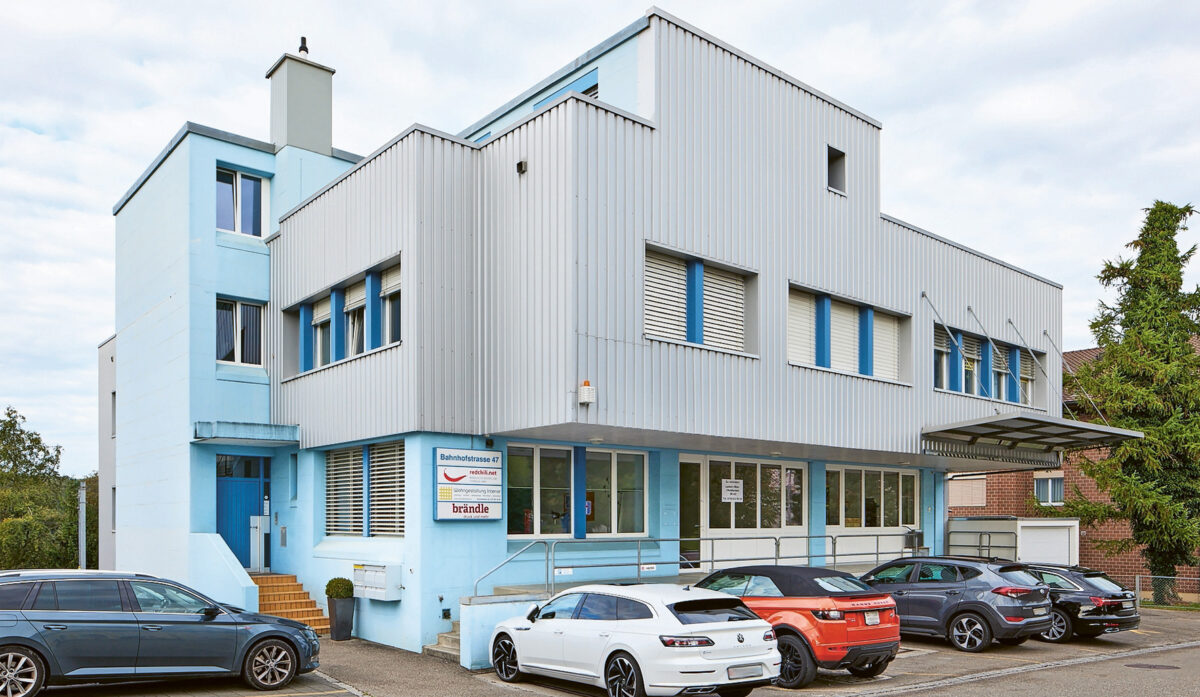
For decades, Brändle Druck AG, based in Mörschwil, has positioned itself as a traditional print shop. With the arrival of a partner company with a different focus, the SME print shop has undergone an astonishing internal transformation within a very short space of time. At the center of this change is the installation of an HP Indigo 7K. A look at a proven digital printing technology that offers graphic arts companies a great deal of development potential, especially in today's market environment.
Dani Tobler, Managing Director of Brändle Druck AG, is a man who likes to laugh a lot. That's why conversations with him quickly become a relaxed affair. But as we all know, running a graphic arts company with a focus on print is anything but a relaxed affair these days. Brändle Druck AG is a company with thirteen employees, eighty years of history, excellent regional roots and many long-standing and close customer relationships. Of course, the increasing shift of communication to digital, combined with lower print runs, was also felt here. Less was printed, but more frequently. Although the market was becoming increasingly difficult, it still offered interesting opportunities and prospects. Then came the pandemic. The trend towards digitalization increased even more, while at the same time it became increasingly difficult to generate growth with the existing business model. Dani Tobler on the development: "We made savings where we could and did everything we could to become even more efficient." However, operating in a purely cut-throat market without any real growth prospects is not great. Dani Tobler: "In an SME, you can only reduce staff up to a certain level. At some point, there comes a point where you simply can't reduce any further without destroying your own service offering. It was clear that with our business model of an independent SME print shop with industrial printing and a regional focus, we had to go over the books in view of market developments."
Generate growth
Dani Tobler explains the initial situation. "We were and are a healthy company with a broad customer base and an excellent regional position. But that alone no longer generates growth in today's market environment. It was therefore clear to us that if things went on like this, we would reach a point in the long term where there would only be three options left: To give up the business, merge with a competitor or reduce the business model to a print broker that outsources all of its print jobs." However, thanks to a broad network of contacts, a successful and growing media company with a national focus became aware of Brändle Druck AG. They were looking for an economically sound and flexible commercial print shop with an existing regional customer base and an experienced team as an ideal addition to their own company model. Under the new ownership structure, Brändle Druck AG would be able to take over all the small print products from the cooperation partner, as well as develop new business areas. But it was not quite that simple. In order for Brändle Druck AG to implement the desired business strategy, it had to change its production technology.
Efficient and flexible
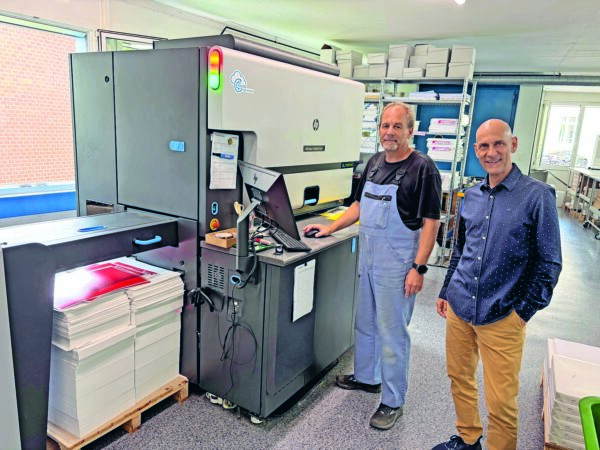
The media company's entry into Brändle Druck AG was therefore based on a clear requirement: in order to be able to cope with future market conditions in terms of production technology and to take advantage of growth opportunities, it was necessary to invest in a genuine industrial digital printing system as a second mainstay alongside industrial offset printing. A considerable investment. But this was the only way to achieve the desired business model transformation. We could actually end the report at this point. An HP Indigo 7K was installed in Mörschwil in 2024. The system quickly became the backbone of production. Even though the five-color sheetfed offset press in 50×70 format from 2011 is still in the pressroom. It will remain there for some time to come, but practically everything that Brändle Druck AG has been able to book as new print jobs in the last twelve months runs on the industrial digital printing system.
In this context, it is naturally interesting to know why Brändle Druck AG opted for the HP Indigo 7K. Dani Tobler explains: "If it had only been a question of taking over traditional commercial small print products from our new partner, the decision would probably have been very different. But that would have been a continuation of the existing business model, and nobody wanted that. In the new partnership, there are many small orders that are not processed on paper, but on other materials such as plastic. There are also numerous orders in the form of POS materials and packaging. So on the one hand, we needed a digital printing system that could process traditional commercial job types on an industrial scale. On the other hand, the system had to be able to process special and heavy materials without compromising on quality and productivity."
View of the supplier
This is where the CHROMOS Group, which sells, supports and maintains HP Indigo systems in Switzerland and Austria, comes into play. The "deal maker" on the CHROMOS Group side was Heinrich Maag. He has been known in the industry for many years as "Mr. Offset" of the Dielsdorf-based company. However, due to the structural changes in the market, the CHROMOS Group decided to adapt its sales and customer service structures to the changed circumstances. Until a few years ago, there was a dedicated sales channel for offset and one for digital printing - a system that no longer reflected current market requirements. Heinrich Maag comments: "Customers today don't want an offset or a digital printing solution. They want the right solution for them, and the printing technology is only a means to an end."
The CHROMOS Group's sales team was therefore reorganized and Heinrich Maag became an all-rounder, offering both RMGT offset machines and digital printing systems to customers. For him, who had long worked as a service technician in his professional career and only later "slipped" into the role of salesman, this was not a challenge, but a logical consequence of technological changes and, above all, market developments. A development that, according to Heinrich Maag, opens up prospects for a company like the CHROMOS Group: "Originally a trading company, we have developed into a solution provider. As we are not a subsidiary of a supplier of printing presses or digital printing systems, but sell solutions independently, we can work in a much more open-ended way. This could be an offset press in one case and a digital printing press in another. That is the big difference to our competitors. Even if it is not communicated in this way, their ultimate aim is to sell the systems produced by the parent company as well as possible on the market. You can no longer approach an investment project with one hundred percent neutrality." Regarding the case of Brändle Druck AG, he says: "The entire investment project shows very clearly how the industry is changing. With our representations of HP Indigo, Fujifilm Revoria and RMGT, we offer our Swiss customers exactly what they need to be able to develop independently in industrial printing. With the HP Indigo 7K, we were able to offer exactly the solution that the company really needed in Mörschwil."
The HP Indigo 7K
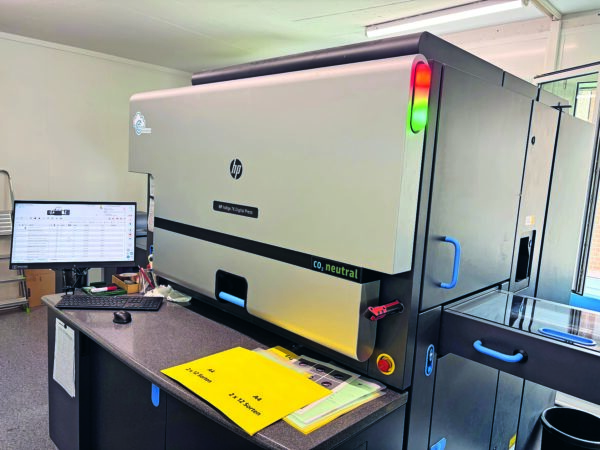
The HP Indigo 7K is described in the CHROMOS Group's sales information as follows: "One machine - endless possibilities". The CHROMOS Group has been distributing HP Indigo products in Switzerland for many years. This includes the entire range. Today, this includes the 7900CPO and the 7K in SRA3+ format, the 12000CPO, 18K/18K HD and the 120k in B2 format. The 6900CPO and 6K model series for flexible materials and labels, the V12 for the highly industrial label sector, the 20000CPO and 200K for flexible packaging, the 35K for the specialized cardboard sector and the 7K/6K Secure for security printing. In addition, there are the Revoria toner systems, which round off the range "downwards". It is a comprehensive portfolio for industrial printing in Switzerland.
For years, HP Indigo was synonymous with industrial digital printing in good print quality. This has changed in recent years, at least in the commercial market. There are now several competitor inkjet systems in B3 and B2 format that also offer very good print quality. Some print shops have therefore opted for these offerings in the last three years. At Brändle Druck AG, however, inkjet solutions were not an issue after thorough analysis. Dani Tobler explains: "We were looking for a printing system that could handle not only all possible commercial types, but also packaging and POS jobs equally well. The inkjet systems available on the market today are undoubtedly impressive in terms of their productivity and efficiency. However, as soon as the job profile moves outside the mainstream, these systems no longer cover this optimally. The fact that the inkjet solutions available on the market only work in CMYK and do not offer spot colors is hardly ever discussed. With the new machine, on the other hand, we not only wanted to process things that we have always produced as a commercial print shop, but also implement projects that we have not been able to realize up to now. We wanted a kind of Swiss army knife. The HP Indigo 7K meets this requirement profile far better than its competitors in the inkjet segment." Heinrich Maag agrees with him: "HP Indigo is backed by over twenty years of experience. No other digital print provider covers such a broad portfolio. Thanks to the integration of the primer in one of the seven inking units, the HP Indigo 7K 'eats' everything you give it, from substrates with 60 g/m2 to 550 g/m2. It is a highly flexible and at the same time industrially productive system that covers all market needs."
Internal and external changes
Brändle Druck AG has been producing with the HP Indigo 7K for around a year. The machine processes orders that come from new business partners. But thanks to the new machine, the company can offer things in the marketing, POS and packaging segments that were not possible before. Since the installation of the Indigo, Brändle Druck AG has been generating growth again. For Dani Tobler and his team, this is a pleasing but also challenging development. He admits with a grin: "Today we have to prepare as many quotations per day as we used to in a whole week. The number of orders has increased significantly, and many of these orders are more complex and of higher quality. At the same time, we have expanded our logistics and shipping business. Thanks to the HP Indigo 7K, we have good prospects again. This positive development is having an impact on the climate in the company. Our team has more work, but it's more fun! We are not only processing new or complex jobs on the Indigo. We can print a lot of what we used to produce in offset just as well on the 7K." Do we still need offset at all? Daniel Tobler thinks for a moment: "We certainly wouldn't invest in an offset press at the moment, but we can't do without it yet. The same can be said of the sheet-fed toner system, where demand is covered. Thanks to the HP Indigo 7K, the prospects for the coming years are extremely positive. A larger format such as SRA3+ is quite conceivable if developments continue as we have seen so far. With a B2 machine from Indigo, we could perhaps replace offset completely. But, as I have already mentioned, we cannot yet do without offset." Heinrich Maag concludes: "Many people in the market tell me: HP Indigo is expensive. I always say: What do you want to do with your machine in the future? Do you always want to do the same thing or develop further? There is no more powerful and flexible all-rounder in industrial digital printing than the systems from HP Indigo. With an HP Indigo 7K, I can serve existing customers as a 'classic' B2 SME offset printer, but at the same time develop completely new market segments. That brings me more than an inkjet system that is slightly more productive for purely standard jobs, because you can't get any further with standard alone these days."
This article was published in August 2025 in the trade journal Swiss Print + Communication
Find out more about our solutions for digital commercial sheetfed printing:

Contact us
Seizing opportunities in digital commercial sheetfed printing? Our experts will be happy to help you. Please contact us.


