
Text and images: Paul Fischer, Swiss Print + Communication
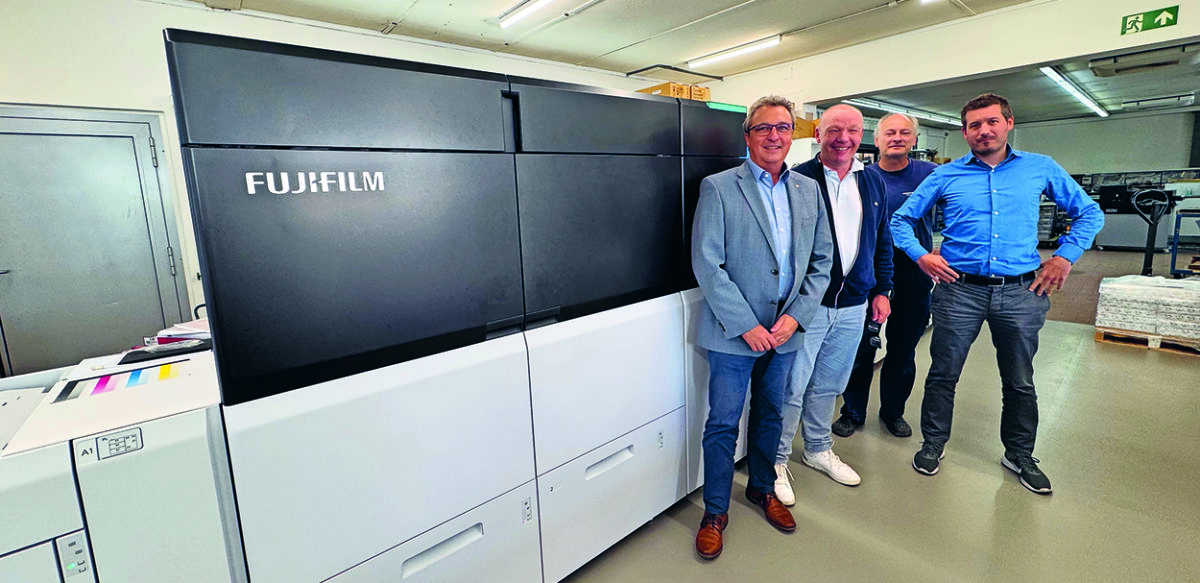
The Landquart AG printing company, part of SL Druck+Medien AG, recently installed two industrial B3 sheetfed toner systems from Fujifilm: a PC1120 and an EC2100. This raises the question: why toner? And why Fujifilm? Site manager Remo Thöny and general manager Thomas Ambühl revealed their reasons. The investment decision was based on a combination of business realism and confidence in a high-quality production resource from a previously underestimated supplier.
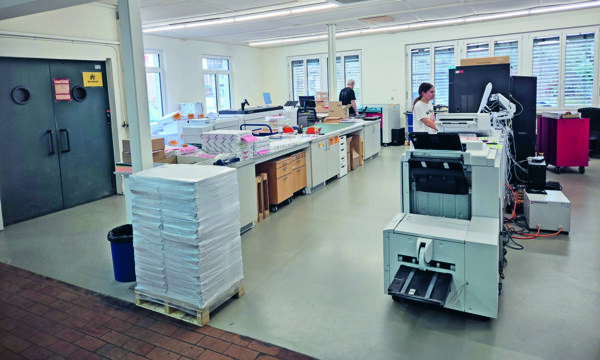
SL (Sarganserländer) Druck+Medien AG is a typical example of how the consolidation process has changed the printing industry in Switzerland. In 2018, Druckerei Landquart AG became part of Sarganserländer Druck AG. At the same time, Thomas Ambühl, previously head of Druckerei Landquart AG, took over as head of all printing sites at SL Druck+Medien AG. The main location is in Mels, where newspapers were once produced until this contract was transferred to the new newspaper printing center in Haag in 2006. The newspaper printing center is operated by Südostschweiz Partner AG (Sopag). Several publishing houses are involved in the company. SL Druck+Medien AG is a major shareholder in the company. With the addition of Druckerei Landquart AG, the production resources were focused: Mels is home to industrial offset printing with multicolor sheetfed offset machines in B3 and B2 formats. Advertising technology and industrial digital printing were concentrated in Landquart. It therefore only makes sense to consider the investment decision from the overall perspective of the company.
The fundamental questions
SL Druck+Medien AG's production concept is "modular." The newspaper business, which is hugely important for the company, is handled in terms of production technology by Sopag in Haag, of which it is a co-owner. As mentioned above, the rest of the printing business is divided between Mels and Landquart. Industrial digital printing was concentrated in Landquart, involving toner systems in the B3 format range. After around five years in use, the issue of a successor solution became topical. The simplest and most obvious investment was to replace the existing toner systems with new-generation machines. However, in a rapidly changing market environment, such considerations are no longer sufficient. At a time of permanent declines in print volumes and an increasing number of small print runs, the question arises as to whether sheetfed offset machines are still the right basis for the coming years. And since attractive systems for the B3 sheet format have been available on the market in the industrial inkjet segment, the question also arises as to whether B3 sheet toner devices still make sense. That is why the division of labor for this evaluation was clear: Remo Thöny, site manager of the printing facility in Landquart, focused primarily on what was happening in the toner market. Thomas Ambühl looked at it from an "overachiever's perspective." As one of the first in Switzerland to retrofit an existing conventional sheetfed offset press with UV LED technology more than ten years ago, he was trusted to come up with some surprises. But there were no big surprises. Instead of setting up an inkjet solution, as many other industrial sheetfed offset printers in Switzerland are doing, the company remained committed to toner digital printing. However, the decision to go with Fujifilm did break new ground. Why did Landquart decide this way and not another?
sense of reality
Thomas Ambühl and Remo Thöny are sitting at the table during the discussion in Landquart. It is a lively discussion in which both make clear statements. Thomas Ambühl: "Between 35 and 40% of our industrial printing sales are generated through digital printing. These are impressive figures for us. When I think about how small the sales figures were when we started digital printing 14 years ago, the changes are enormous." And what do the figures for offset printing look like? Thomas Ambühl: "Both in absolute terms and in terms of sales share, offset printing has seen a steady decline over the same period." In view of these developments, wouldn't industrial inkjet printing have been an important topic? Thomas Ambühl thinks for a moment and explains: "Our existing fleet of sheetfed offset presses is relatively young. With machines that are between five and six years old, we are still state-of-the-art in terms of production technology. From an amortization perspective alone, it would not make sense to consider a replacement investment at this stage. I am a firm believer in LED UV drying technology in sheetfed offset, and all our machines are equipped with it. Hypothetically, we would certainly have the opportunity to transfer even more orders from offset to industrial inkjet digital printing. In reality, however, with the advantages of LED UV offset, this is not really an option. Even with strong growth in digital printing in recent years, the print and sales volume achieved here is simply not enough to justify the investment in a B3 inkjet machine for the digital printing business.
Given the impressive growth in digital printing, couldn't one have said, "We'll get the rest from the market"? Thomas Ambühl laughs out loud and says, "I don't believe anyone who tells me that additional sales volume can simply be generated in today's Swiss printing market. Yes, maybe you can get it, but only with prices that don't even cover costs. Do I want that? Certainly not. In any case, I can't imagine that all the B3 inkjet sheetfed presses now coming onto the market can really be filled with orders. We ourselves simply don't have the print volume for an industrial inkjet sheetfed press currently available on the market, which is why there was no alternative to industrial toner printing as a replacement investment. But we clearly wanted to go for the best solution, not the cheapest."
That's why Revoria
This is where Remo Thöny comes in. He looked at the various offerings on the arc toner market. During the evaluation phase, a previously overlooked supplier emerged for those responsible in Landquart: Fujifilm. The credit for bringing this solution to the attention of the Landquart team undoubtedly goes to Heini Maag from the CHROMOS Group, which distributes Fujifilm's Revoria toner systems in Switzerland. A visit by Remo Thöny and Thomas Ambühl to Fujifilm's new Customer Experience Center in the run-up to Drupa 2024 clearly made an impression. Remo Thöny: "To be honest, we weren't even considering Fujifilm at the start of the evaluation process. Heini Maag had to work hard to convince us and pique our interest. When we saw the new systems in Fujifilm's showroom for the first time and analyzed the print results, it quickly became clear to me that this was a new and very serious player on the market." What is so impressive about Fujifilm's products? Remo Thöny: "Definitely the extended color gamut with the various special colors and the better print quality compared to the competition. The machines themselves are also very high quality across the board. In sheetfed printing, in the color control processes, in the various grammages." Thomas Ambühl adds: "The two Revoria systems we purchased impress with their quality and flexibility. But of course, the systems are a bit more expensive, it has to be said. However, this additional cost is more than justified."
These are statements that Heini Maag naturally likes to hear. He explains the philosophy that Fujifilm pursues in the toner business: "Fujifilm has been in a close partnership with Xerox for decades. Many users in Switzerland were unaware that the Xerox machines they were using were actually developed and built by Fujifilm. After Fujifilm and Xerox ended their active technology partnership five years ago (author's note: Xerox still purchases basic print engines from Fujifilm), it was necessary to reorient the business. A new generation of toner systems was developed based on the company's own expertise. The focus was clearly on quality over quantity. The machines now available on the market are based on decades of experience, and Fujifilm is clearly committed to developing and building the best toner machines on the market."
The two machines
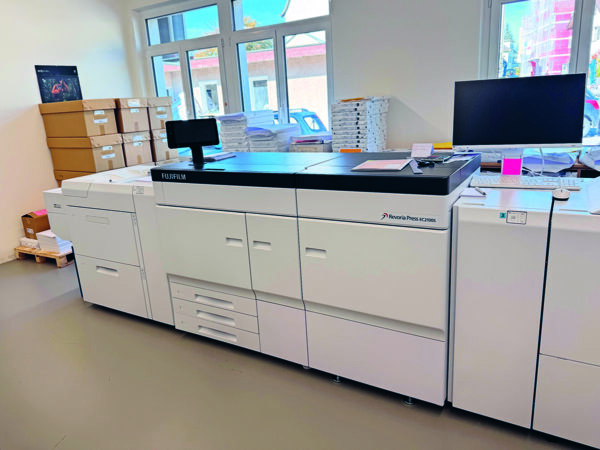
Two machines were installed in Landquart: a Revoria Press PC1120, currently Fujifilm's fastest toner sheet-fed press with 120 pages per minute in six-color printing, and a Revoria Press EC2100S for 100 pages per minute in five-color printing. The Revoria Press PC1120 six-color machine is a highly automated system with stability and image quality that make it ideal for the print-on-demand market. Accordingly, the Revoria Press PC1120 offers a wide range of feeding and post-press options, simplifying the production of even high-quality and demanding print products.
According to Fujifilm, the new Revoria Press EC2100 combines industrial printing speed with high-quality image quality and offers versatile options for anyone who needs both speed and excellent color reproduction. With high-resolution LED technology offering 2400 × 2400 dpi resolution, 10-bit image processing, and advanced real-time color optimization, the EC2100 delivers crisp, detailed prints regardless of the media type. Intelligent image optimization ensures smooth color gradients, fine details, and improved skin tones. At the same time, advanced five-color printing with special toners enables creative printing solutions with unusual effects.
More than satisfied
Thomas Ambühl is thoroughly impressed by the new machines, which have been in use for several months: "The print resolution and extended color gamut currently make the Revoria models the best available in the industrial toner segment." Remo Thöny says: "These are toner systems with all the fundamental strengths and, of course, weaknesses that this technology brings with it. But Fujifilm has obviously invested a great deal and continued to develop the technology. As Thomas said, the machines simply print better than what we have been used to in the toner sector up to now. Fujifilm's systems also impress in terms of service and availability." Heini Maag also thinks the new Fujifilm models are a good thing: "With HP Indigo in the highly industrial segment and solutions that demand much more than just the standard, we are well positioned. Fujifilm rounds off our range of standard solutions. More precisely: standard solutions with added value. That's an important argument. In addition, with RMGT we offer a comprehensive range for offset printing." Thomas Ambühl: "Fujifilm really surprised us with its capabilities and offerings. There is now a new player in the market that is providing real impetus. That's good for our industry."
This article appeared in December 2025 in the trade journal Swiss Print + Communication.
Learn more:


Contact us
Seizing opportunities in digital commercial sheetfed printing? Our experts will be happy to help you. Please contact us.