
How B. Braun Medical AG in Sempach Ensures Capacity, Control, and Flexibility with the Digicon 3.
B. Braun Medical AG employs approximately 1,150 people in Switzerland across three production sites, two dialysis centers, and a medical device reprocessing facility. The Sempach site manufactures disinfection and hygiene products for hands, skin, and mucous membranes, as well as for instruments and surfaces, and products for the treatment of chronic wounds.
For B. Braun, labels are not merely a marketing tool, but an integral part of product safety and compliance. Each year, the company produces a very large volume of labels, distributed across numerous marketable products, each of which is available in many different language versions within a single packaging design. What sounds like traditional industrial production actually takes place within a strictly regulated medical technology environment.
Flexibility as a strategic driver
As early as 2009, B. Braun decided to bring label production in-house. The deciding factor was not primarily the cost structure, but rather responsiveness. “It was certainly a matter of flexibility—and thus time-to-market,” explains Stefan Feer, Team Lead for Labeling & Print Services. “The frequent and numerous label changes require a high response speed, which is why corresponding adjustments must be implemented flexibly and at short notice.”
In a regulated environment, changes to text, symbols, or regulatory notices often require immediate action. Companies that rely on external supply chains in this context lose valuable time. Today, B. Braun in Sempach produces almost entirely on demand. Inventory levels and disposal costs have been reduced, and time to market has been shortened.
Regulatory requirements such as the MDR or UDI played a minor role in the initial decision. Nevertheless, they act as indirect catalysts. “Regulatory authorities naturally welcome the prompt implementation of their requirements for changes,” said Feer.
Patient safety determines the labeling
In the medical technology and pharmaceutical sectors, patient safety is the top priority. Labeling must comply with a wide range of regulatory requirements. Each stage of the process comes with its own set of specifications. The complexity is evident in the scope and variety of label production. Every year, a very large volume of labels is printed, die-cut, and made available for production. The variations range from single-language country-specific designs to comprehensive multilingual master designs. With the commissioning of a new production facility in Sempach, the volume continues to grow.
Capacity and Redundancy as an Investment Strategy
Specialized professionals work in label production. The setup is intentionally streamlined, and the processes are clearly structured. In early 2026, B. Braun commissioned a second finishing system, a Digicon 3 from AB Graphics. The investment is directly linked to the expansion of production capacity. “With additional filling lines, the demand for labels automatically increases. Without our in-house print department, we wouldn’t be able to meet this demand,” says Matthias Pfister, Process Engineering Project Manager. At the same time, the company wanted to build redundancy. Individual electronic components of the existing Digicon 2 will no longer be available as spare parts in the long term.
External production partners serve as a backup. However, ramping up external capacity takes time and requires additional logistics. “The deciding factors were the higher capacity and the internal security, complemented by the added flexibility for future growth,” said Pfister.
Structured evaluation and ergonomic design
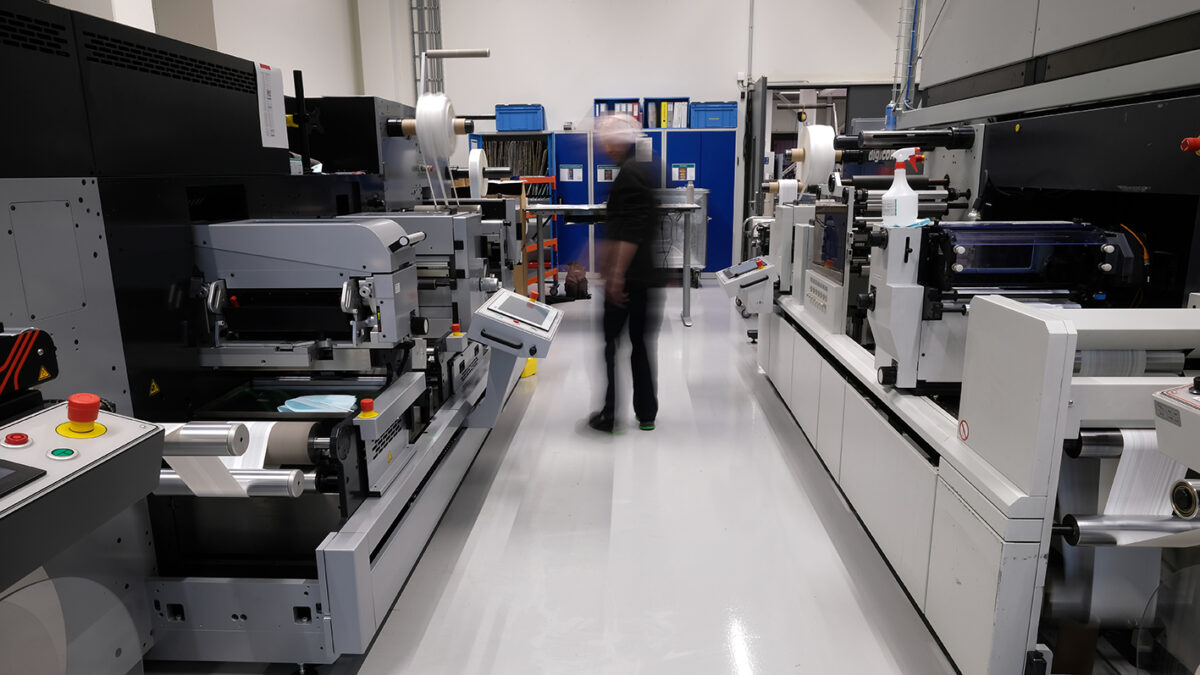
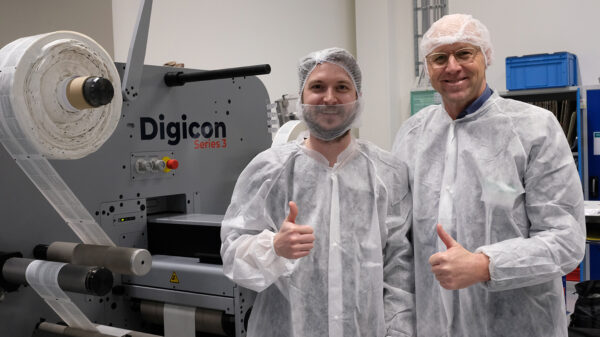
The evaluation was based on a detailed specification document containing requirements from various departments. A structured comparison revealed that the Digicon 3 from AB Graphics best meets the defined criteria. A key element is the system layout. The existing Digicon 2 operates from right to left, while the new one operates from left to right. The two machines are positioned opposite each other in a mirror image. An operator can monitor both systems from a central location. This increases efficiency and improves ergonomics.
Functionally, the new system had to cover the entire range of labels. At the same time, the Series 3 offers technical advancements such as the AutoSlit function, which increases the level of automation and has a positive impact on output. Modular expandability was also a key criterion. A "light" version was considered but ruled out because it would not have allowed for future expansions or changes in the direction of operation. The investment was intended to ensure long-term flexibility.
Integration and Validation in a GMP Environment
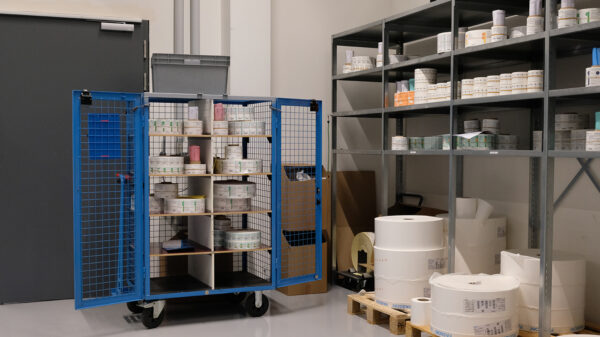
A little over a year passed from the start of the proposal phase to the production release. Once the FAT was complete, the technical implementation proceeded quickly. Integrating the system into the existing production environment required structural modifications. To accommodate the mirror-reversed layout, the existing equipment was relocated and the external control cabinet was mounted to the ceiling using a specially designed bracket. This pragmatic solution has proven effective in operation. Printing takes place in the same room on two inkjet systems. Design and content creation are handled in-house. The control system initiates the respective print job, monitors the process, and documents all steps.
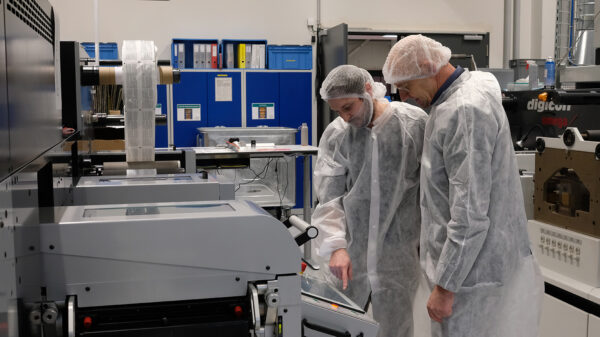
In a regulated environment, the technical installation is only one part of the project. Specifications, test plans, risk analyses, maintenance plans, and work instructions form the foundation. This is followed by factory acceptance testing at the supplier’s facility and site acceptance testing, including installation, functional, and performance qualification. Once all steps have been completed, the quality department issues final approval.
During production, every label is inspected after printing and finishing and recorded in the batch documentation. A camera system for 100% inspection is about to be implemented and will enable fully digital batch documentation with feedback to the control system in the future.
Measurable results and operational benefits
In a direct comparison with the Digicon 2, the performance improvements are clearly evident. “Above all, the faster cycle times are distinctly noticeable, and the difference in performance is more pronounced than we had originally expected,” reports Pfister. The advantage of in-house production is also evident when it comes to product changes. “We would generally be able to implement adjustments into production within a very short time,” says Feer. While approval processes still take time, external sourcing cannot keep up with this speed. Another benefit lies in process control. “A major advantage is certainly that we have the entire process—from design through approval to printing—under our own control.” This end-to-end control strengthens audit security and compliance.
Between Standardization and Customization
Labeling requirements are constantly evolving. “There will always be a balancing act between standardization and customization,” says Feer, describing the challenge. At the same time, regulatory requirements are increasing and shaping the variety of products available. Topics such as e-labeling have been under discussion for years. The potential is there, but physical labeling remains essential. “What will always remain is the need to ensure patient safety,” emphasizes Feer.
Partnership as a Key to Success
In addition to technology and processes, the system partner plays a crucial role. “In addition to technical expertise, a quick response time is crucial for us,” says Pfister. This aspect was already included in the evaluation criteria during the assessment.
B. Braun has been working with CHROMOS Group AG since the installation of the first Digicon in 2009. The partnership includes consulting, installation, and ongoing support. Especially in the initial phase following commissioning, quick responses and practical solutions were essential. When asked whether the project would be implemented the same way today, the answer is clear: “Yes, under the same conditions, we would implement the project exactly in this form again.”
For B. Braun in Sempach, the decision to invest in a second Digicon 3 is not an isolated purchasing decision. It is part of a clear strategy to ensure flexibility, compliance, and production reliability. For companies outside the traditional graphic arts sector, this example illustrates the role that in-house finishing can play in regulated industries.

Contact us
Want to find out more? Our experts will be happy to help you.
Contact us: